
Ayurveda: Meaning, History, Benefits, Limitations, and Its Business Perspective in India (Detailed Explanation)
Introduction
Ayurveda is one of the oldest traditional systems of health and wellness in the world and is deeply connected to India’s cultural and historical identity. For thousands of years, people have practiced Ayurvedic principles as a way to support healthy living, daily routines, food habits, and overall well-being. In modern times, Ayurveda is no longer viewed only as a traditional practice—it has also become a major part of India’s wellness, herbal, and consumer product economy.
The term Ayurveda comes from two Sanskrit words:
- Ayur = Life
- Veda = Knowledge or Science
Together, Ayurveda means “The Science of Life.”
Its traditional philosophy emphasizes maintaining balance in lifestyle and supporting long-term well-being rather than focusing only on illness after it appears.
Today, Ayurveda influences multiple sectors including:
- Health and wellness
- Herbal and personal care products
- Nutrition and food industries
- Education and research
- Tourism and wellness centers
- Business and entrepreneurship
This detailed explanation covers Ayurveda’s meaning, historical development, principles, benefits, limitations, business opportunities, challenges, and future in India.
1. Understanding Ayurveda
Ayurveda is traditionally understood as a complete lifestyle system rather than only a treatment approach.
It generally includes:
- Daily habits
- Nutrition choices
- Physical activity
- Sleep routines
- Stress management
- Plant-based formulations
- Seasonal adjustments
- Wellness practices
The central idea is that health is influenced by how people live, eat, rest, and manage daily activities.
According to traditional Ayurvedic concepts, each individual has unique characteristics and may respond differently to lifestyle choices.
2. The Core Philosophy of Ayurveda
Ayurveda views health through a broader perspective.
Traditional Ayurvedic understanding often includes:
Balance
Well-being is associated with maintaining balance in body functions and lifestyle.
Prevention
Supporting health before problems develop.
Individual Differences
Recognizing that individuals may benefit from different routines.
Long-Term Living
Focusing on habits that can be maintained over time.
3. The Three Doshas
Ayurvedic literature commonly describes three functional concepts called Doshas.
Vata
Traditionally associated with movement and communication.
Characteristics often linked:
- Activity
- Motion
- Flexibility
Pitta
Traditionally associated with transformation.
Characteristics often linked:
- Energy
- Processing
- Internal regulation
Kapha
Traditionally associated with stability and nourishment.
Characteristics often linked:
- Structure
- Support
- Balance
Ayurveda traditionally suggests that maintaining harmony among these concepts supports wellness.
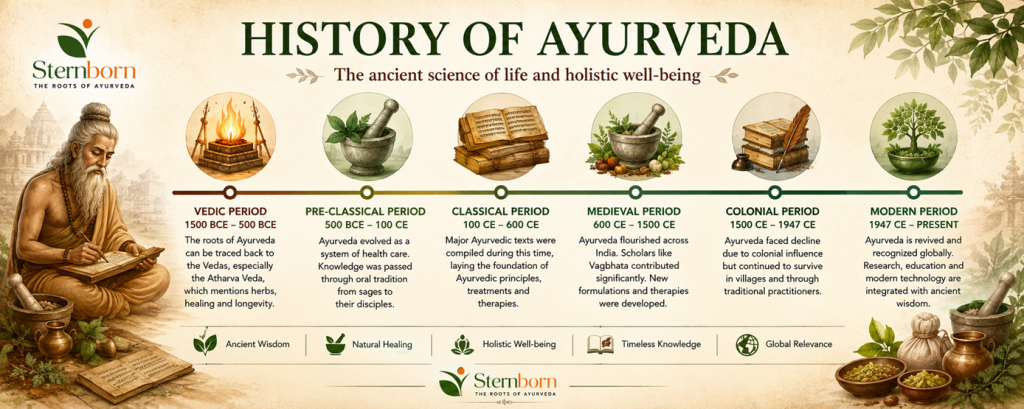
4. Historical Development of Ayurveda
Ayurveda developed over long periods through observation, documentation, and cultural practices.
Ancient Indian civilization placed significant importance on health and daily living.
Important classical texts include:
- Charaka Samhita
- Sushruta Samhita
- Ashtanga Hridayam
These texts discuss health concepts, lifestyle, wellness practices, and traditional medical understanding.
Ancient Period
Knowledge was traditionally transmitted from teachers to students.
Focus areas included:
- Observation
- Diet
- Plant-based preparations
- Healthy living
Medieval Period
During this phase:
- Regional variations developed
- Knowledge spread to broader populations
- Additional practices emerged
Modern Period
Today Ayurveda exists through:
- Educational institutions
- Research organizations
- Manufacturing industries
- Wellness centers
- Consumer product companies
5. Main Branches of Ayurveda
Traditional Ayurveda includes several areas of focus.
Lifestyle Practices
Daily routines and healthy living.
Nutrition
Food habits and balanced eating.
Wellness Therapies
Relaxation and body-care approaches.
Herbal Formulations
Traditional plant-based preparations.
Rejuvenation Concepts
Supporting long-term wellness.
6. Daily Lifestyle in Ayurveda
Ayurvedic traditions emphasize routines.
Examples include:
Morning Routine
- Regular wake time
- Hydration
- Personal care
Eating Habits
- Consistent meal timing
- Mindful eating
Activity
- Regular movement
Sleep
- Structured sleep schedule
7. Nutrition in Ayurveda
Food has traditionally been considered an important part of health.
Ayurvedic dietary ideas often emphasize:
- Fresh foods
- Seasonal eating
- Balanced meals
- Moderation
Nutrition is commonly linked with:
- Energy
- Daily functioning
- Long-term wellness
8. Global Growth of Ayurveda
Ayurveda has expanded beyond India.
Global interest has increased in:
- Wellness products
- Natural personal care
- Lifestyle practices
- Herbal traditions
Reasons include:
- Growing wellness awareness
- Interest in preventive health
- Demand for plant-based products
9. Benefits of Ayurveda
A. Preventive Approach
Ayurveda traditionally encourages maintaining healthy routines.
B. Holistic Perspective
It often considers multiple aspects of life:
- Food
- Activity
- Rest
- Environment
C. Lifestyle Improvement
Encourages:
- Consistency
- Balance
- Daily discipline
D. Natural Product Appeal
Many consumers prefer products inspired by traditional ingredients.
E. Long-Term Wellness Focus
Emphasizes sustainable habits.
F. Integration With Wellness Trends
Ayurveda is often connected with:
- Yoga
- Mindfulness
- Healthy living practices
10. Limitations and Challenges
Ayurveda also has important limitations.
Scientific Evidence Varies
Evidence differs depending on:
- Product
- Practice
- Health condition
Product Quality Differences
Quality standards remain important.
Self-Medication Risks
Professional guidance can be important.
Emergency Care Limitations
Emergency situations generally require immediate medical care.
Marketing Challenges
Responsible communication matters.
11. Ayurveda and Indian Society
Ayurveda holds cultural significance in India.
Reasons include:
- Historical familiarity
- Traditional acceptance
- Increasing wellness awareness
Consumers today often seek:
- Wellness support
- Lifestyle products
- Herbal alternatives
12. Ayurveda as an Industry
Ayurveda has developed into a structured business ecosystem.
Major sectors include:
Medicines
Herbal Products
Wellness Services
Personal Care
Nutrition
Functional Foods
Distribution Networks
13. Major Business Models
Manufacturing
Creating products under regulatory frameworks.
Distribution
Supplying products across regions.
Franchise Expansion
Growing through local networks.
D2C (Direct to Consumer)
Online-first brand development.
Export
Serving international markets.
14. Why Ayurveda Has Business Potential in India
Large Population
India offers a broad customer base.
Traditional Awareness
Consumers are familiar with Ayurvedic concepts.
Digital Commerce
Online platforms expand reach.
Wellness Demand
Health-conscious purchasing continues to grow.
15. Business Opportunities in Ayurveda
Herbal Wellness Brands
Building trusted consumer products.
Educational Content
Providing awareness and guidance.
Regional Distribution
Expanding market access.
Private Label Manufacturing
Creating customized products.
International Markets
Developing export opportunities.
16. Factors That Build Successful Ayurvedic Businesses
Quality
Consistency creates trust.
Transparency
Clear information matters.
Customer Education
Explaining products responsibly.
Compliance
Following regulations.
Branding
Creating long-term recognition.
17. Challenges for Ayurvedic Businesses
Competition
Consumer Trust
Product Differentiation
Supply Chain Management
Market Education
Digital Competition
18. Technology and Ayurveda
Technology is shaping modern Ayurveda through:
- E-commerce
- Consumer education
- Manufacturing improvements
- Customer support systems
- Digital marketing
19. Sustainability and Ayurveda
Future growth increasingly depends on:
- Responsible sourcing
- Environmental awareness
- Ethical business practices
- Long-term resource planning
20. The Future of Ayurveda in India
Future development may involve:
- Research growth
- Better manufacturing standards
- International expansion
- Consumer awareness
- Technology integration
The future direction appears increasingly connected with combining traditional knowledge and modern expectations.
Conclusion
Ayurveda represents far more than a historical wellness tradition. It has evolved into a broad ecosystem connecting culture, lifestyle, education, wellness, and business.
Its principles emphasize healthy living, consistency, and long-term habits. At the same time, responsible product development, realistic communication, and quality standards remain important.
In India, Ayurveda continues to grow as both a cultural heritage and an economic opportunity. Businesses, consumers, and wellness communities increasingly view Ayurveda as an area with long-term potential—supported by trust, quality, education, and innovation.
As awareness grows and industries evolve, Ayurveda is likely to remain an important part of India’s wellness and business landscape for years to come.